
Mergen-Smart Factory R&D Project
Mergen development history
Positive Impact of Smart Factory on Cost of Quality
Steel structure manufacturing process
Required Certificate for Steel structure manufacturer companies
Planning and management systems
Required documents for Certificate of conformance
Management systems targeted with Mergen
Mergen is a ERP Software
Mergen is a MIS Software
Mergen is a MRP Software
Mergen is a MES Software
Mergen is an Occupational Safety and Health Management Software
Mergen is a HRM Software
Mergen development history
Mergen is a process tracking and decision support software development project for steel structure manufacturing factories. This R&D project was supported by The Scientific and Technological Research Council of Turkey (TUBITAK) for 42 months between 2018-2021. The project budget is $454,000 in 2018. As of 2025, taking into account US inflation, the current cost is $642,000.
Positive Impact of Smart Factory on Cost of Quality
In a factory at Industry 3.0 level, the profit is 20% as in the 1st column and the total cost of the work done is 80%. As seen in column 2, around 35% of the total cost is spent to make quality production. In column 3, 20% of the 35% quality production cost is internal and external errors. 10% is the cost of evaluating quality and 5% is the cost of trying to prevent errors.
One of the new concepts that comes with Industry 4.0 is Quality 4.0. In the 4th column, thanks to digitalization, real-time quality control reduces the cost of evaluation and non-conformities while slightly increasing the cost of prevention. As a result, better quality manufacturing can be done 25% cheaper.
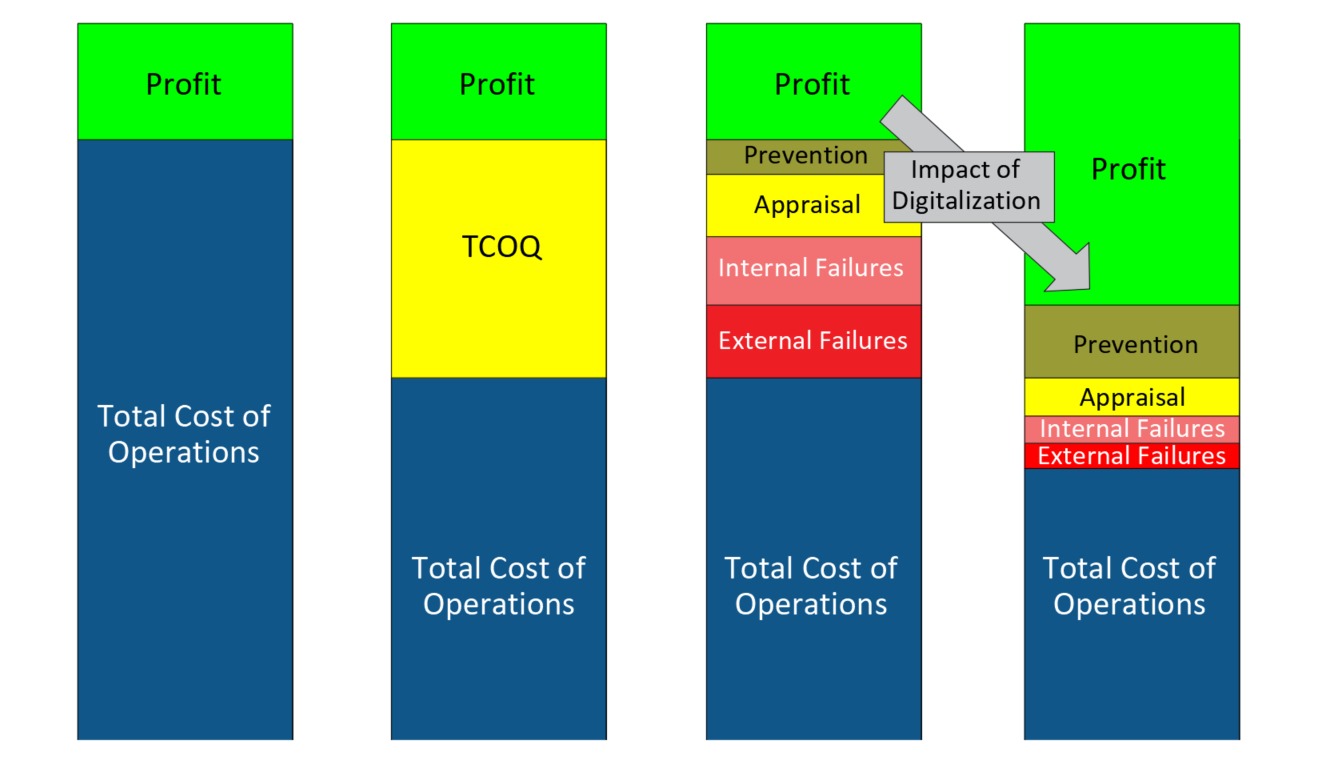
In the Mergen R&D project, digital transformation is aimed in a field with complex production processes in steel structure manufacturing. The fabrication is carried out using technical drawings and DSTV-NC files obtained from the 3D model (IFC) of the steel structure thanks to Building Information Modelling (BIM).
In this project, steel structure manufacturing will be carried out using IFC and DSTV-NC files and production stages will be monitored via 3D model (IFC).
Steel structure manufacturing process
Let's start by explaining our project, the manufacturing processes of a steel structure, when the flow diagram below is examined
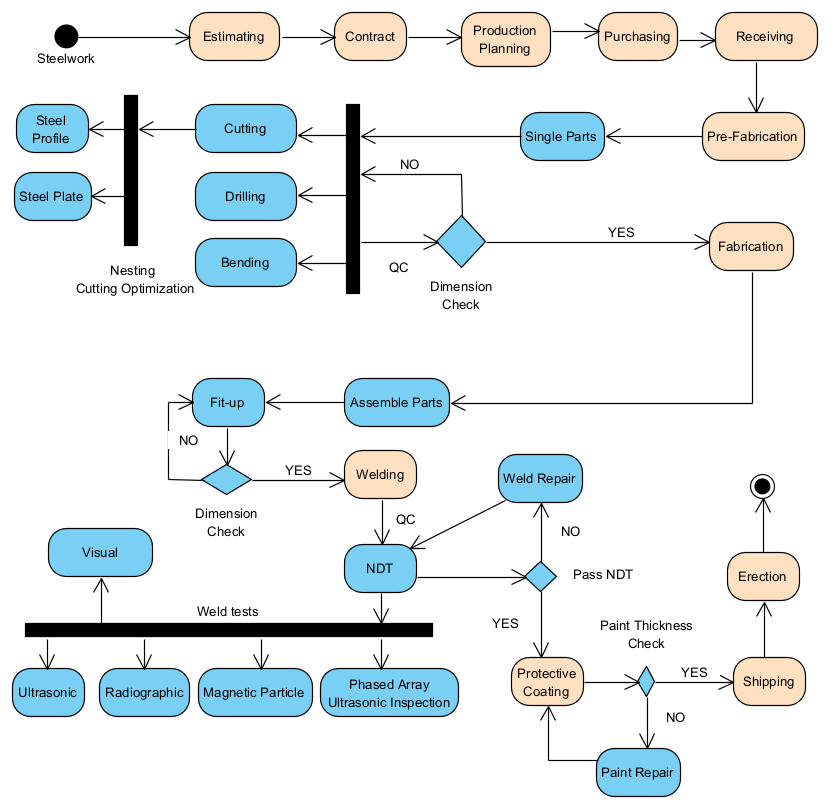
It looks like a structure that can be applied to many factories. Since the steel structure is made once, the type of production in this factory is discontinuous. Since it is customized, it makes it difficult to develop a software project to follow the process due to change requests in the middle of production.
When we came to the end of the project with about 4 years of work (2022), we realized that the software had to be connected to a quality management system. We saw that each factory had a different quality management system. For this reason, instead of including Mergen in their own systems, factories started to request their own systems in Mergen.
In the meantime, we purchased the manuals required for the Certificate, which is compulsory for steel structure manufacturers, whose rules, called AISC Certificate in the USA, are in the AISC-207-16 standard. It was a complete quality management system for steel structure manufacturers.
Required Certificate for Steel structure manufacturer companies
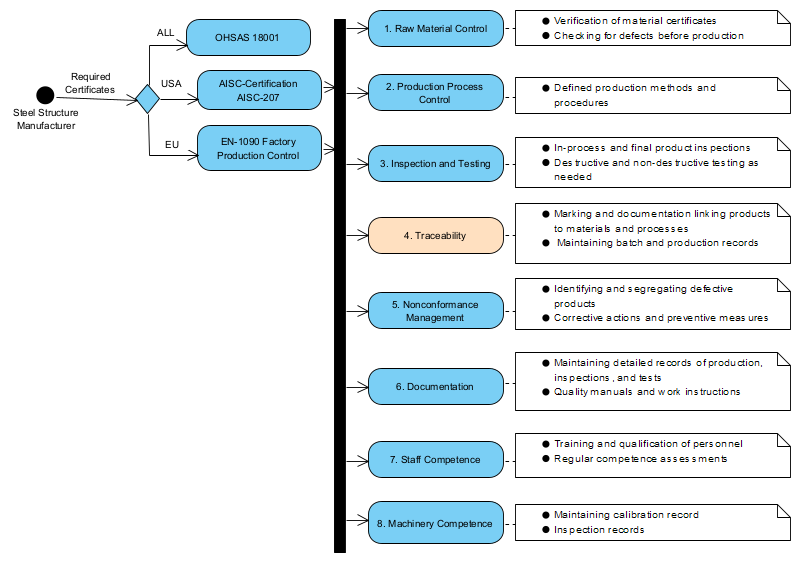
In this direction, we continued to develop Mergen. In order to understand the subject, let's briefly examine the certificates required for the steel structure manufacturing factory targeted with Mergen.
Planning and management systems
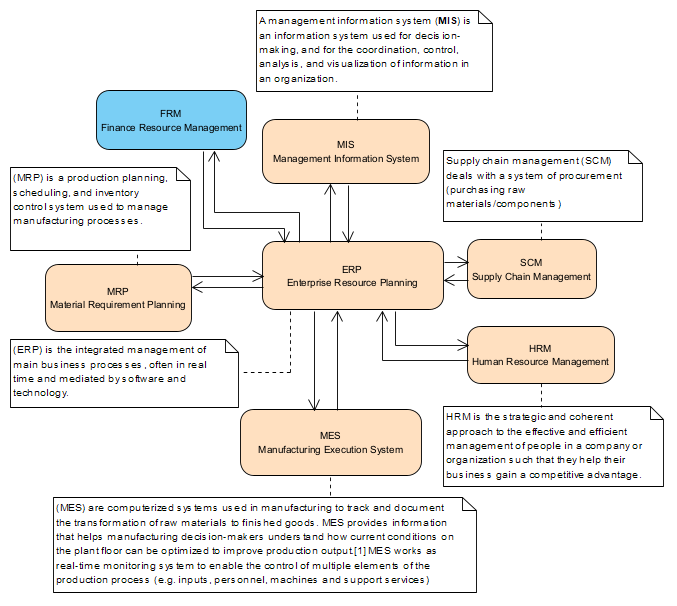
Nowadays, management and planning systems used in industry such as ERP, MRP, MES, MIS, CRP, FRP are widely used. For example, integrating an ERP system to mass production factory takes more than a year. In factories with discontinuous production, this period can be significantly longer.
Required documents for Certificate of conformance
The steel structure manufacturing company must certify that it meets the necessary quality requirements when delivering the final product to the customer. For this purpose, the factory must have AISC Certification in the USA and EN-1090 Factory Production Control Certification in the EU.
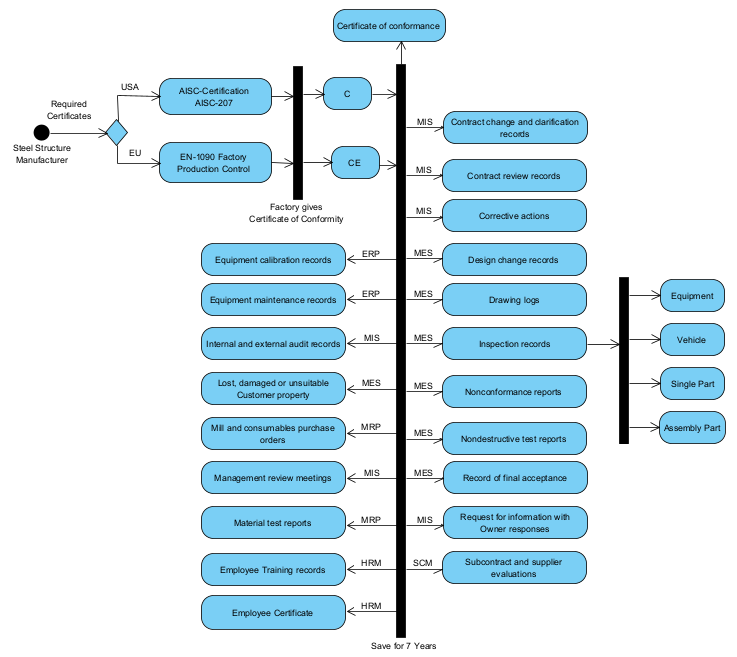
The biggest problem for the manufacturer is the multiplicity of documents that must be provided when issuing the “Certificate of Conformance” to the customer. Although a company that manufactures 100 tons of steel structures per month can produce these documents using MS-Word MS-Excel, this is a huge task for a company that makes 1000 tons per month.
When the above diagram is analyzed, it is concluded that many management and planning systems should be used together
Management systems targeted with Mergen
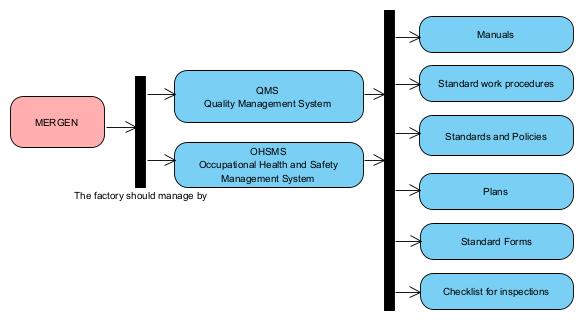
Accordingly, we realized that Mergen should not only be a factory production software. We have developed it, to be
- a MIS software that shows to the management what is going on in the factory,
- a MES software that enables real-time detection of problems in production,
- and an ERP software that can be used for resource planning for the structure to be produced.
While doing this, we tried to adhere to the management systems that related to Quality / Occupational Health and Safety, so that the transition period of the factory to Mergen would be very short.
Mergen is a ERP Software
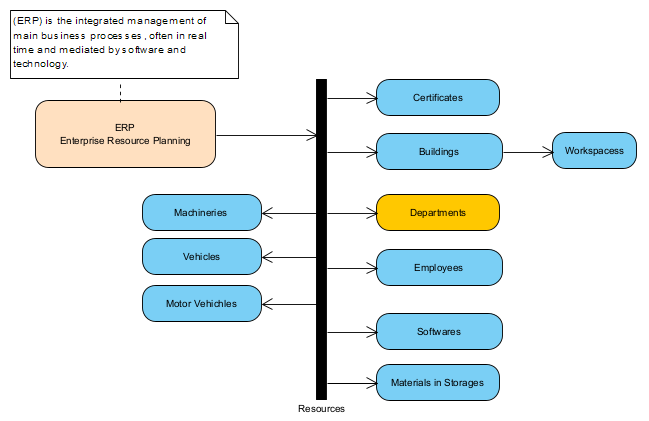
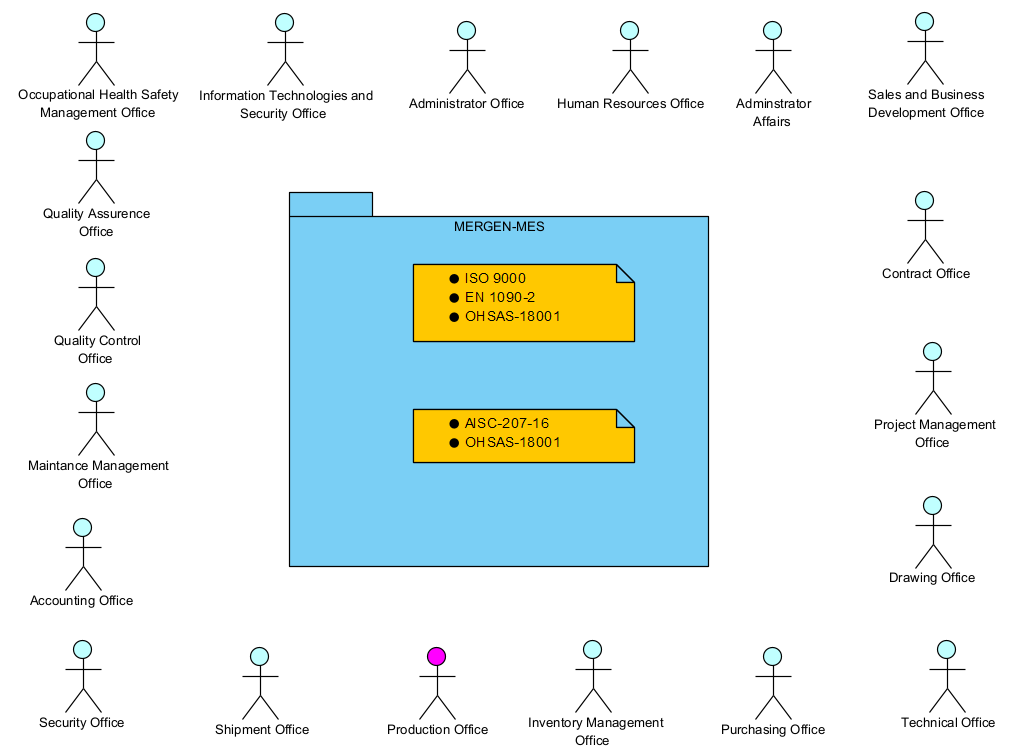
In a steel structure manufacturing factory, there are mainly the above departments. In Mergen, there is a separate module for each department. Let's take the Production Office as an example.
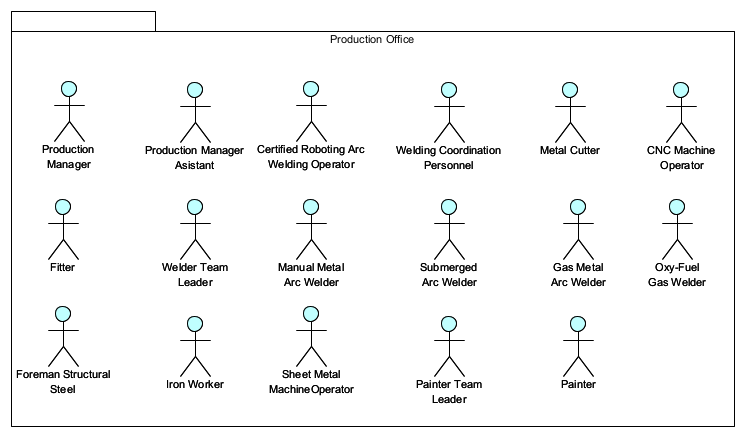
The roles of the people in this office are given above. Role holders who have the authorization to use the relevant module in Mergen can access it. The operations they can do according to each role are limited.
Mergen is a MIS Software
Since all departments within the factory use the same system and database, information is collected in one place. By using this data accumulated over time, information can be obtained to improve the efficiency of the factory.
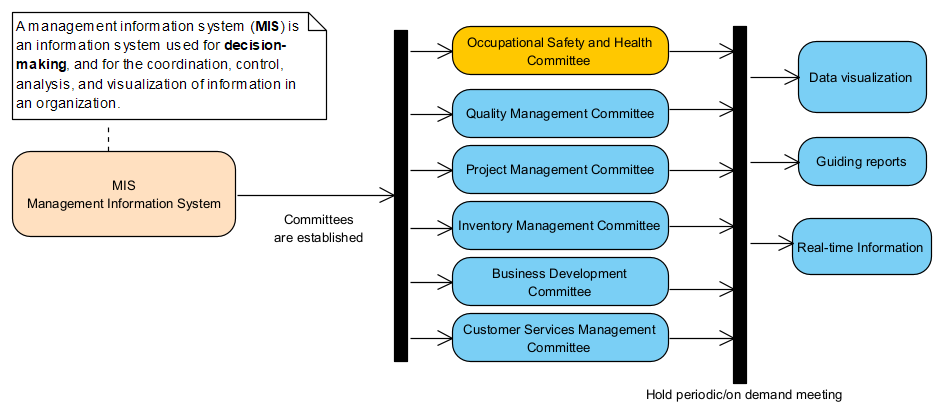
The Quality Management System (QMS) and Occupational Health and Safety Management System (OHSMS) require the establishment of several committees and periodic meetings of these committees.
In these meetings, the data accumulated in the Mergen database can be used for data visualization, guiding reports and real-time tables. This information is intended to be tailor-made for the meeting. Let's take the Occupational Safety and Health Committee as an example here
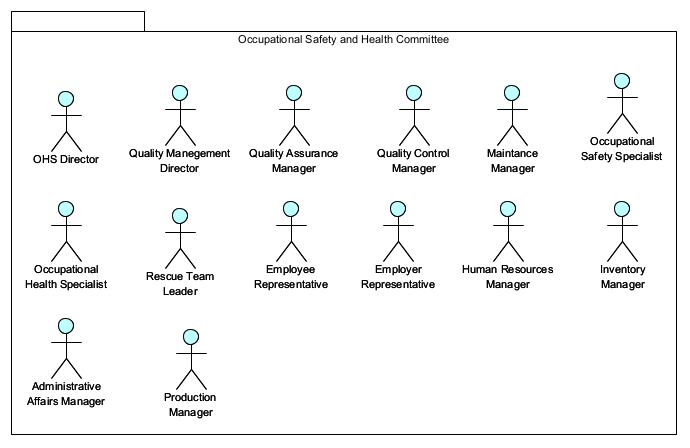
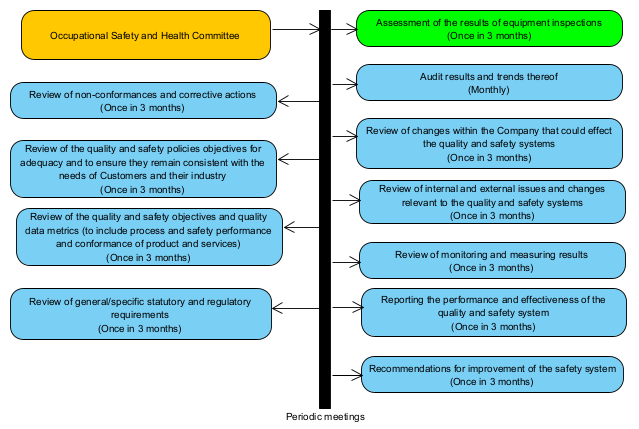
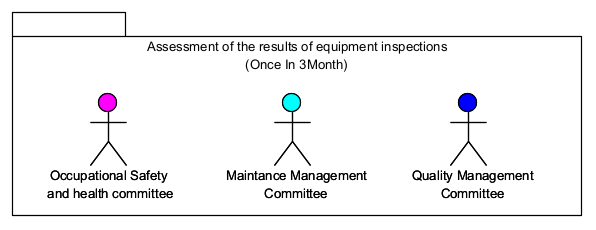
The diagram above shows the periodic meetings that the Occupational Safety and Health Committee should hold. Take the meeting “Assessment of the results of equipment inspections”. This meeting is held by more than one committee.
The topics given in the diagram below will be discussed at the meeting. Mergen's goal is to visualize the information about the meeting topic using the data in the database to guide the management and save time.
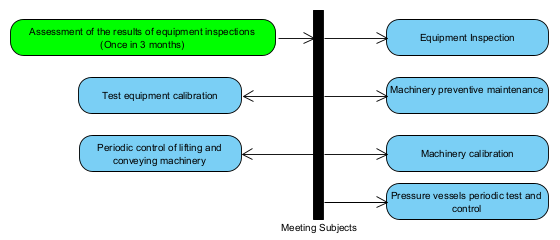
Today, most of this information is in MS-Excel sheets. Analyzing the data and preparing meaningful reports is labor intensive and depends on the competence of the preparer.
Mergen is a MRP Software

Manufacturing stages are given in the diagram below. In the planning phase, the project is divided into parts such as phase, batch and lot by considering the erection order.
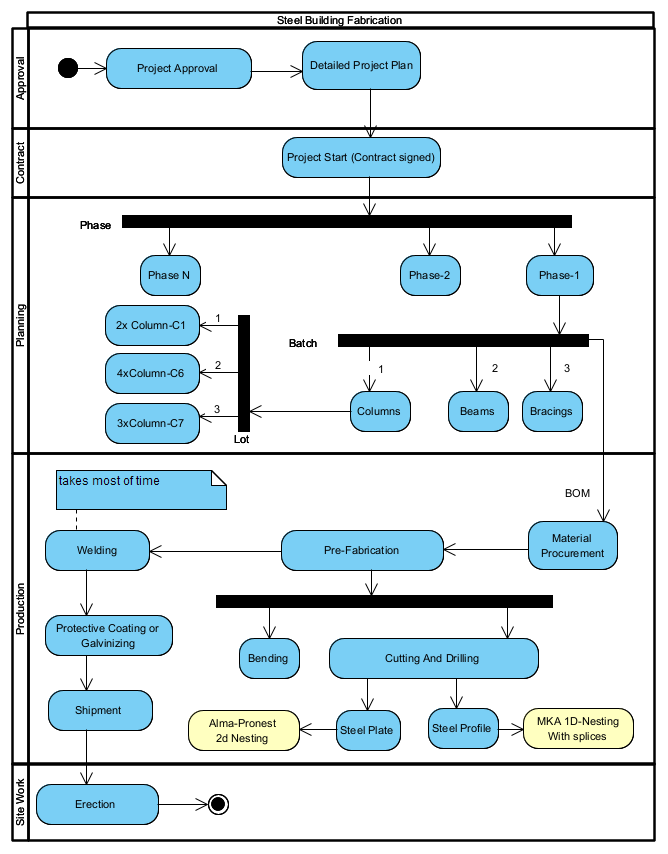
In the production phase, the time required for material procurement varies according to the supplier. The pre-production stage is usually quite fast because CNC machines are used. However, the welding stage is time consuming. The type of welding, quantity, number of welders, competence of welders determine the duration of this stage.
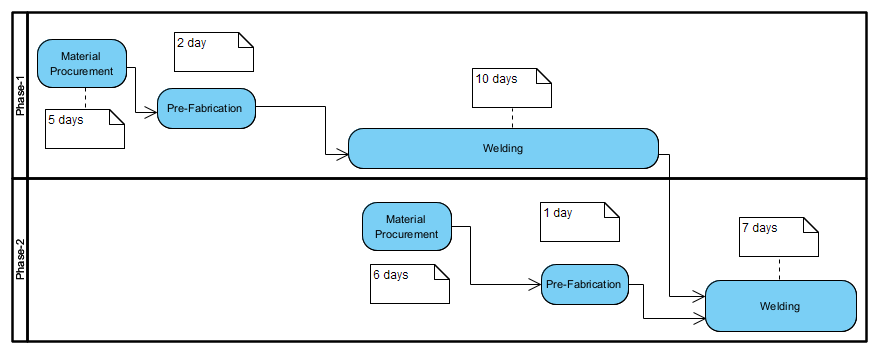
When the above diagram is analyzed, the welding phases of the project is completed in (5+2+10+7=24) days. The materials of phase2 should be supplied 7 days before the end of the Phase1 welding stage. In other words, the materials of Phase2 should be ordered 10 days after the start of the project at the latest.
The above plan may show deviations due to many reasons such as delay in material supply, incorrect estimation of welding quantity, detected weld defects during quality control, absenteeism of welders.
It is important to create the production plan. However, it is much more important that the plan be followed in real time. Therefore, Mergen should also be a MES software.
Mergen is a MES Software

The roles of the people in this office are given above. Role holders who have the authorization to use the relevant module in Mergen can access it. The operations they can do according to each role are limited.
For single parts
Steel plates and profiles are cut and processing according to special cutting plans. This is an attempt to minimize waste. After this process, measurement control is performed to check the calibration of the CNC machine. Before the fit-up stage, the part numbers are written on or the individual part barcode is affixed.
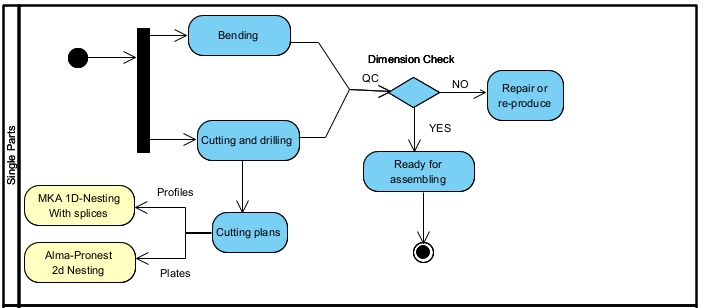
By digitally monitoring this process, it is possible to know which assembly parts are ready for the fit-up stage.
1D Nesting with splices for getting steel profile cutting plans
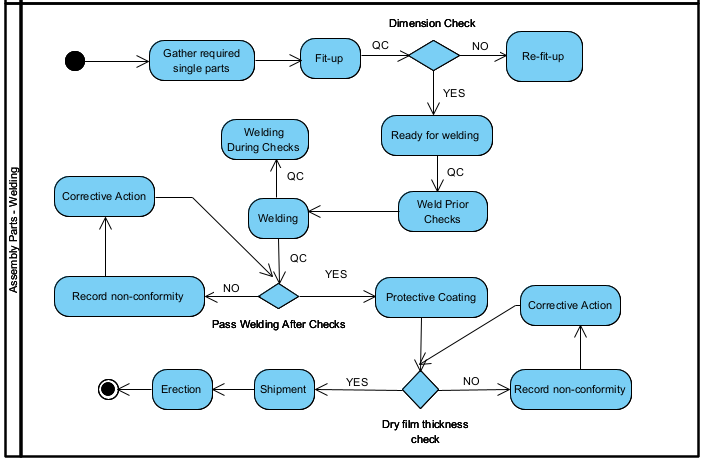
For assembly parts
Fit-up and welding are the most critical stages. In the fit-up stage, the individual parts to be welded on the assembly part are spot welded for dimensional control. For the CE certificate to be delivered to the customer, a record showing that this control has been carried out is required.
There are controls to be carried out before, during and after the welding stage. Records of these controls will be delivered to the customer. If weld defect is detected at the source, a record of this will be kept. Thus, the defective assembly part and the welder who made this error can be followed.
Mergen is an Occupational Safety and Health Management Software
Occupational Safety and Health Management and quality management systems are similar to each other in many respects.
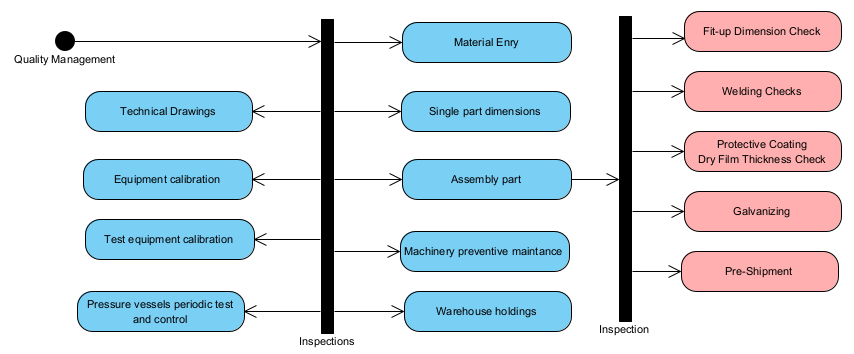
In order to be able to issue a Certificate of Conformity, the quality management system is required to carry out the above-mentioned audits and to keep the records and to keep them for 7 years.
Standardized checklists are needed to obtain meaningful data after these audits.
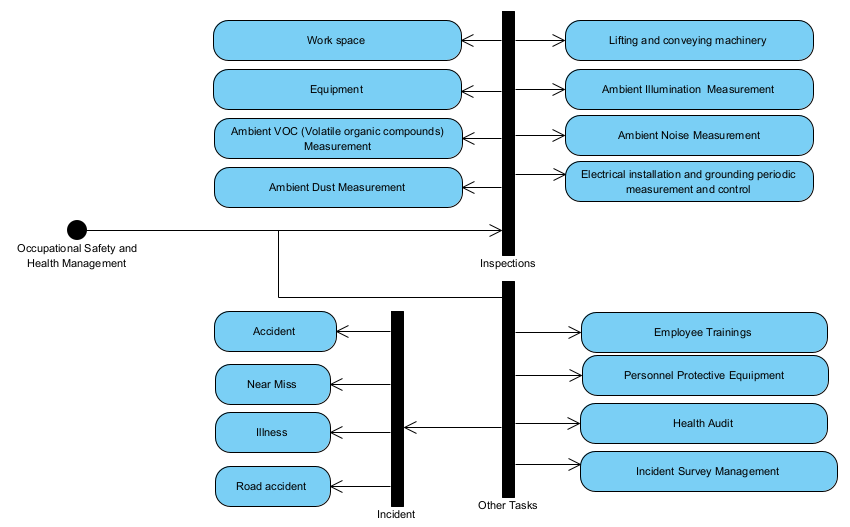
When the standardized checklist method used in audits related to quality management is used for occupational health and safety management, it is possible to monitor the hazard and risk status of the factory in real time.
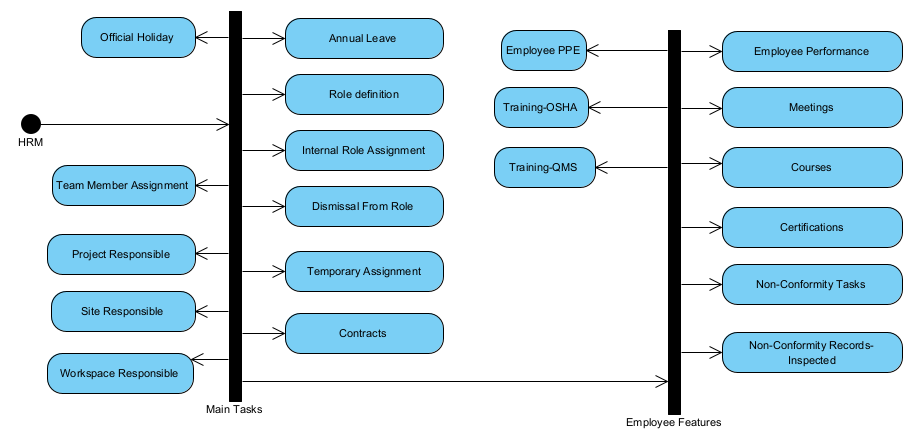
Mergen is a HRM Software

Mergen-Steel Profile Processing Center R&D Project
The most important of the steel building pre-fabrication stages is the cutting and drilling of individual parts. In this project, different solutions for the processing of steel profiles are proposed.
Current Situation
Problem Definition
Our proposed solution
Current Situation
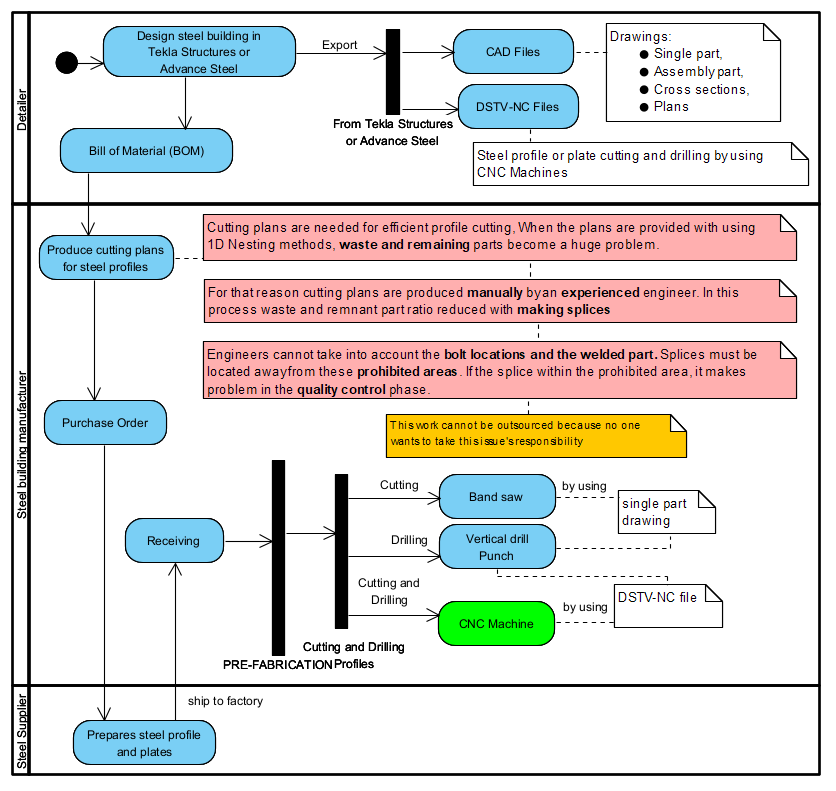
Detailer: The detailing of the steel building is done using software such as Tekla Structures or Advance Steel. From this model, single parts, assembly parts, cross-section and plan drawings required for manufacturing and erection are taken.
The purpose of using this type of software is that the production is one-to-one with the 3D model. This is only possible by using DSTV-NC files used by CNC machines.
Steel building manufacturer:
- Steel profiles are in a standard length at the material suppliers. Using the list of materials at hand and according to the standard profile length (usually 12m), a specialized and experienced engineer prepares the cutting plans.
- The purchase order is issued according to the quantity and stock length information obtained. After the steel profiles arrive at the factory from the supplier, the cutting and drilling process starts.
- In large manufacturers there are CNC profile cutting and drilling machine. These can perform precise and fast manufacturing using DSTV-NC files.
- Small manufacturers use band saws and vertical drills. The speed of the process is slow, the precision depends on the worker.
Problem Definition
In the cutting plans prepared using the 1D Nesting software available in the market, single parts are placed within the standard stock length (usually 12m), but if no splice is made, it causes a lot of scrap and remnant parts. Let's illustrate this with a real example.

The cutting plan for HEB400 steel profiles, highlighted in yellow, for a stock length of 12.1 m without splices is given below. The following cutting plan consists of 1x4986 and 8 x5932 long remnant pieces.
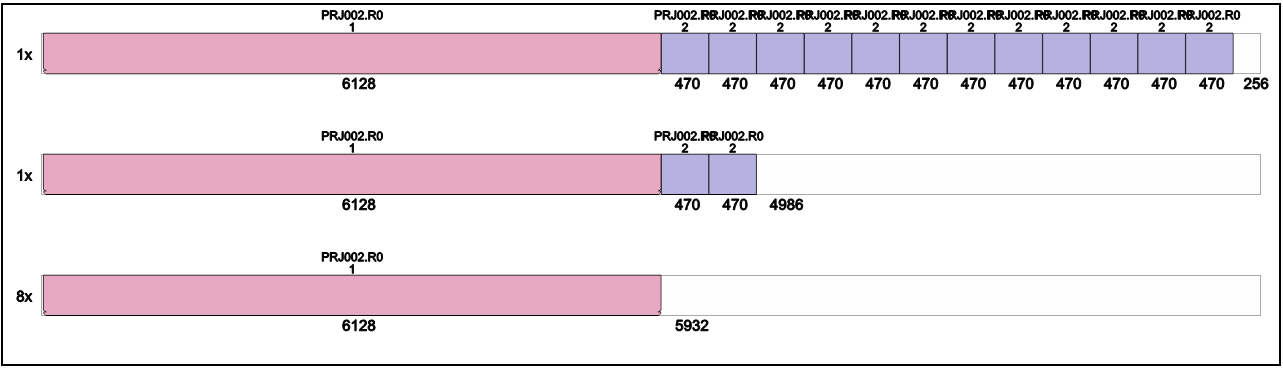
It is often preferable to have a specialized and experienced engineer make the cutting plans by hand, as this results in a significant cost increase. The focus here is on minimizing losses. This requires making splice.
However, engineers often do not consider bolt locations and the welded part. Splices should be located away from these restricted areas. If the splice is in a restricted area, it creates problems in the quality control phase.
If we carefully examine the picture below, there are many plates and beams welded to the single parts of highlighted HEB400. The possibility of collision is quite high. It is really risky to make a cutting plan with splices.

The factory undertakes the quality responsibility by making a cutting plan with splice for steel profiles with its own machine. Depending on the chance, it may not encounter a problem. But generally, not…
If the project-specific stock length could be determined, there would be no need to make a splice. For this purpose, it is necessary to queue at the steel rolling mill and take the waiting time into consideration. However, in most countries this is possible for very high orders (500 tons) and 3-4 months waiting time is inevitable.
| Small steel structure manufacturers can never cut and drill with CNC machines? |
|
a. Large manufacturers’ CNC profile cutting and drilling machines Today, many large manufacturers have CNC profile cutting and drilling machines. Most of these machines operate with 25% efficiency for one week a month. When they are idle, they do not serve small manufacturers who do not have machines for the following reason:
|
|
Small companies must have cutting plans with splice in order to compete with the big ones. b. There is no company providing services for this cutting and drilling process of steel profiles.
|
Our proposed solution
- If a steel profile supplier sets up a facility that provides profile cutting and drilling services, could this be a solution?
- Can the software we have developed solve the problems of this service?
- Will this service increase the sales of the steel profile supplier?
- Could this be a profitable investment?
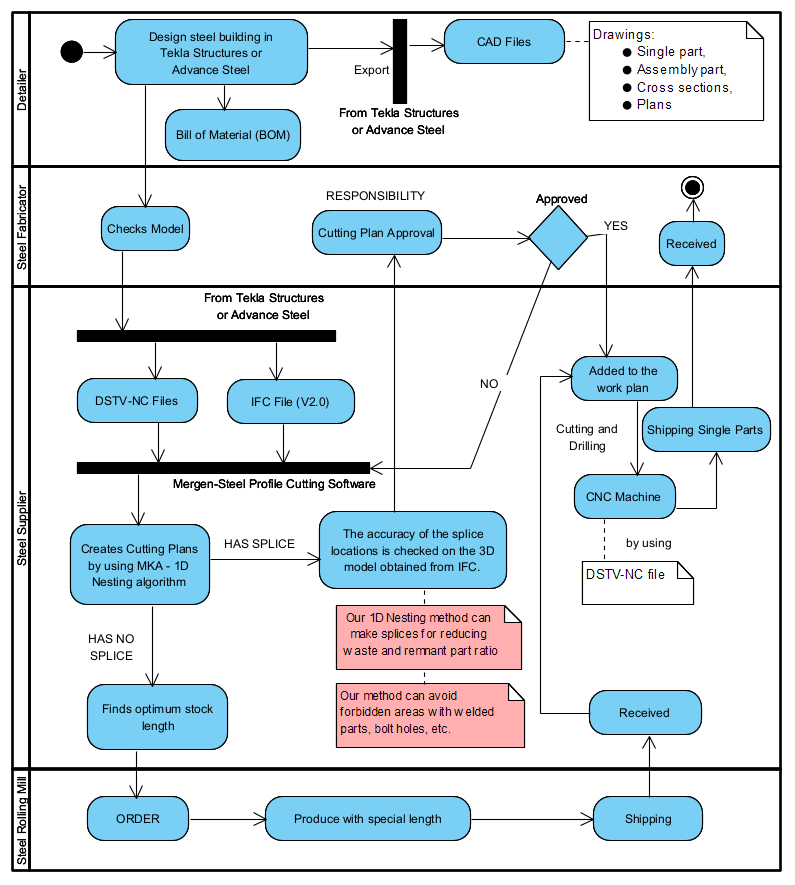
In the activity diagram above, small and medium size manufacturers who do not have CNC profile cutting and drilling machines are taken into consideration.
In the facility, which we call the profile cutting and punching center, only H-shaped steel profiles used as columns and beams will be processed.
a. The Tekla model is checked repeatedly for manufacturing using DSTV-NC Because the manufacturing will be done using these files and it is not possible to go back.
b. After the cutting plan with splice is prepared, the biggest problem is to check the suitability of the splice location. The easiest method for this is to put the splices on the 3D model of the structure and test the collision over the image. The 3D model of the structure can be obtained with an IFC file. Mergen uses the information in the DSTV-NC and IFC type file.
c. In the following cutting plan, the single parts used in the cutting plan prepared in the previous section are used. The difference compared to the previous one is that this time, splicing is allowed in the 1D Nesting algorithm.
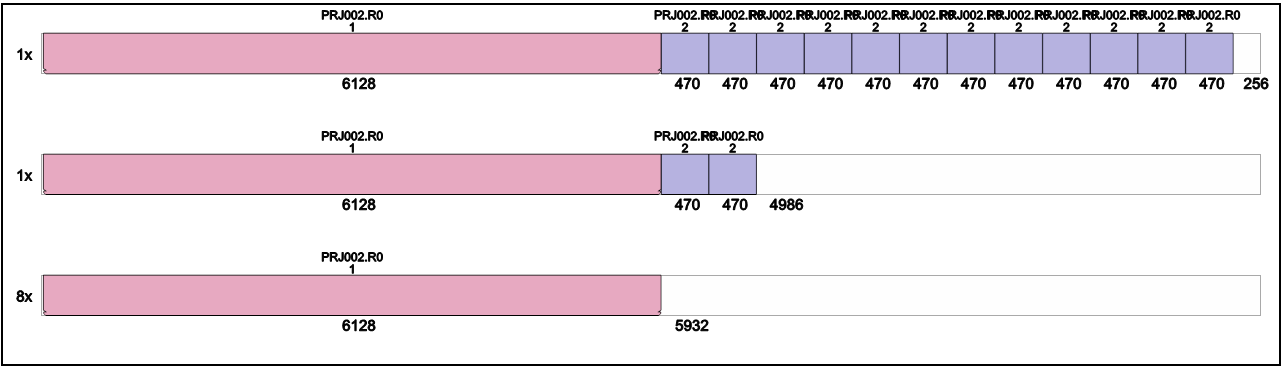
Cutting plan without using splices
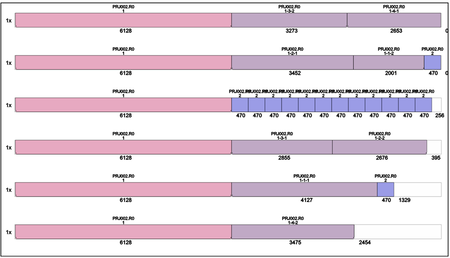
Cutting plan with using splices
The cutting plan with splices is quite successful. Previously it was necessary to use 10 x 12100, now 6 x12100 mm is sufficient.
When determining the splice locations, the following settings were used;
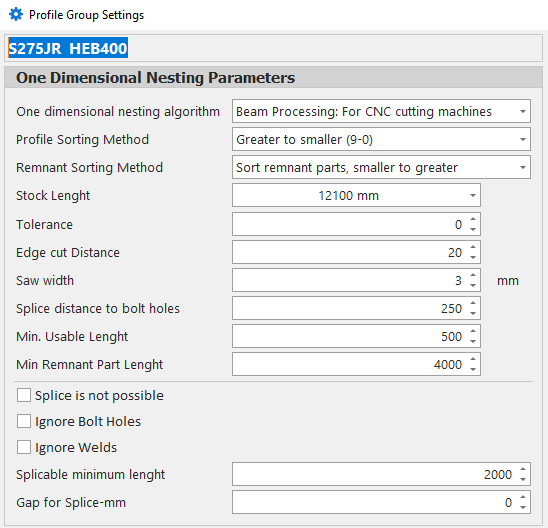
- Standard Stock length 12100mm
- 20mm cut at the ends of 12100 mm stock (Edge cut distance)
- Saw width is 3mm
- Splices can be made at least 250mm away from the bolt group and welding contours
- Minimum length of the part to be spliced is 2000 mm
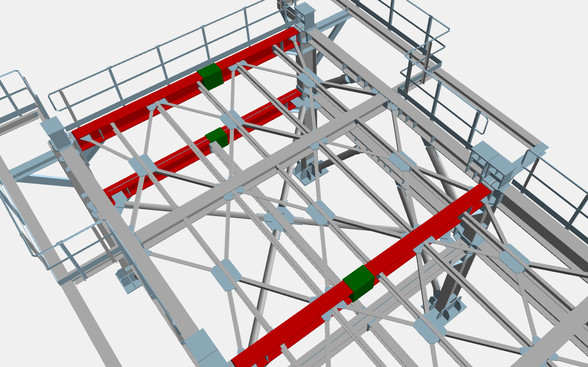
But is the location of the splice good enough? For this, let's examine the 3D model pictures below. The red color represents the spliced beams and the green rectangular prisms show the location of the splice.
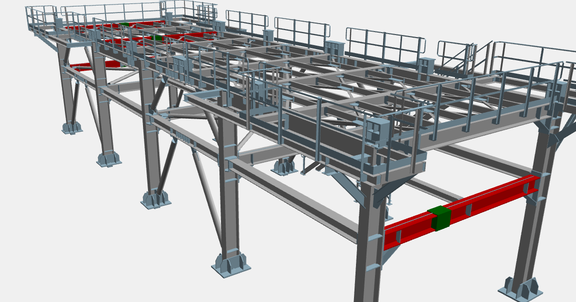
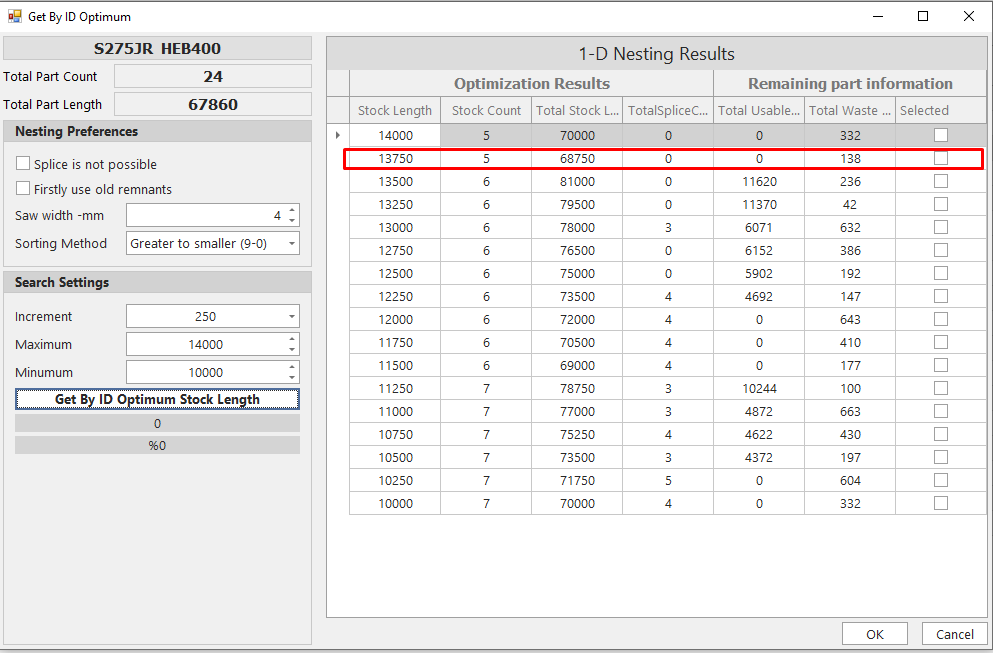
d. In the above shown activity diagram, it is mentioned that in some countries it is possible to order special sizes for the steel rolling mill. In the following user interface, the optimum stock length between 10,000-14,000mm is investigated. There is a cutting plan without splice by using a stock size of 5 x 13,750mm.
It is often inappropriate to wait 3-4 months for a job of this amount (Total ~68m).

e. If the cutting plans are suitable as seen from the 3d model above, the steel structure manufacturer will also approve
f. Mergen can produce a DSTV-NC file specific to cutting length for the parts to be obtained with splice. From now on, according to this cutting plan, it is possible to drill and cut this individual part using the DSTV-NC files we have.
g. Afterwards, quality documents will be prepared and ship to the steel structure manufacturer.
| The software we have developed (Mergen) can solve the problems of this service |